
My wife and I had the fight in the car park at Carrefour.
Not a proper fight – more like an intense disagreement while unloading groceries. She wanted to send our twins to the same British school her colleague’s kids attend. I wanted more options. We’d moved to Dubai six months earlier and suddenly needed to make a decision that would affect the next decade of our children’s lives.
“Everyone says it’s the best British school,” she argued, holding a bag of groceries.
“Everyone also said that restaurant in JBR was amazing and it gave us food poisoning,” I replied.
Not my finest argumentative moment, but it made the point. Popularity doesn’t equal quality. We needed to actually research Dubai British schools instead of just following what other expat families were doing.
Three months, twelve school tours, and way too many spreadsheets later, we enrolled our twins at Apple International School in Karama. Not because it was the obvious choice. Because after digging past the marketing materials and actually understanding what Dubai British schools offer, AICS made sense for our family.
This is everything I learned that the glossy brochures deliberately don’t tell you.
The “British School” Label (And Why It’s Messier Than You Think)
Here’s something that confused me for ages: what actually makes a school “British”?
Is it the curriculum? The nationality of teachers? Whether they serve beans on toast at lunch? I genuinely didn’t know.
Turns out “British school” can mean different things. Some Dubai British schools follow the English National Curriculum exactly as it’s taught in England. Others follow it loosely with adaptations. Some have mostly British teachers. Others have international staff teaching British curriculum. Some prepare students for UK universities specifically. Others use British curriculum but aim for global university placement.
Apple International School follows the English National Curriculum properly – Foundation Stage through to IGCSEs and A-Levels. When I asked how closely they stick to UK standards, the principal said, “We use the same framework, same assessment standards, same exam boards as schools in England. If you moved back to the UK, your children would slot right in.”
That mattered to us. We might relocate back to London in a few years. Maybe. My company keeps hinting about it. Having the kids in a proper British curriculum means less disruption if that happens.
But even if we stay in Dubai permanently, the British system has structure. Clear progression, defined benchmarks, external exams that universities worldwide recognize. That appealed to us more than some of the other options.
Why We Even Started Looking
We weren’t unhappy at the twins’ nursery. They were learning, making friends, seemed content. But they were turning five in August, which meant Year 1 was coming, which meant we needed to make actual decisions.
My wife grew up in the UK. She did GCSEs and A-Levels, went to a British university, understands the system. She wanted the same structure for our kids.
I grew up in the US. I barely understand cricket, let alone the nuances of Key Stages and SATs at age seven. But I trusted her judgment that British curriculum would work for our family.
Also – honestly – most of the expat parents we knew in Dubai had their kids in British schools. Not because they’d done extensive research, but because it’s what everyone does. British curriculum is the default for English-speaking expats in Dubai.
We started visiting schools assuming we’d pick one of the big names everyone talks about. The ones with Outstanding KHDA ratings and waiting lists since birth.
That assumption lasted exactly two school tours before reality hit.
The Tour Circuit (Twelve Schools, One Existential Crisis)
I visited twelve Dubai British schools between February and May. My wife came to most of them. By school number eight, we’d developed a system.
She watched how teachers interacted with students. I counted kids per classroom and asked uncomfortable questions about teacher retention. We’d compare notes in the car afterward, usually discovering we’d noticed completely different things.
The premium British schools (AED 70,000-95,000 annually) were stunning. One had a library that looked like the British Museum. Another had science labs better equipped than some universities. A third had an actual theatre with professional lighting and sound.
But when we observed Year 2 classes, we counted 29 students. When we asked about class sizes, we got PR answers: “We maintain optimal student-teacher ratios to ensure quality education.”
Translation: classes are huge, but we’re not going to say that directly.
The mid-range schools (AED 35,000-55,000) had solid facilities without the architectural showpieces. Normal libraries, decent science labs, standard sports pitches. Class sizes ranged from 24-28 students.
One school we really liked initially had everything we wanted. Great location, good KHDA rating, reasonable fees. Then we discovered they had 45% teacher turnover last year. Nearly half the staff quit. That’s not normal turnover,that’s a sinking ship.
The budget-friendly British schools (under AED 30,000) had basic facilities and mixed KHDA ratings. Some were genuinely good schools working with limited resources. Others were… struggling.
Apple International School fell into that third category budget-wise. Year 1 costs AED 16,700. Not the absolute cheapest in Dubai, but definitely affordable compared to the premium tier.
What sold us? Watching a Year 3 Literacy class during our unannounced second visit.
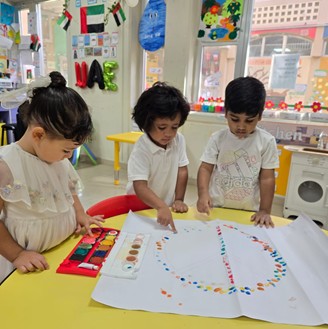
Twenty-one students. One teacher. Kids were doing group reading, discussing a story about some kid who found a magic door. The teacher was moving between groups, asking questions, correcting pronunciation, engagingevery student.
At the premium school we’d visited the previous week, the Year 3 class had 30 students and felt chaotic despite the stunning classroom. Beautiful facilities don’t matter if teachers are too overwhelmed to actually teach.
What Makes Apple International School Different
I’m going to be specific about why we chose AICS over other Dubai British schools.
The class sizes are genuinely small throughout primary. Year 1 and 2 average 20-22 students. Year 3-6 average 22-24. I didn’t take the school’s word for this – I asked to see actual class registers during our tour. They showed me. The numbers were real.
Compare that to British schools charging three times as much with class sizes of 28-30. Where’s the extra money going? Fancy buildings, apparently. Not smaller classes.
The curriculum is properly British. Not “British-inspired” or “British-adapted.” They follow the English National Curriculum exactly. Foundation Stage uses the Early Years Framework. Key Stage 1 and 2 follow national standards. Students take actual Cambridge IGCSEs, not some modified version.
This matters if you might relocate to the UK. It matters if you want your kids applying to UK universities. It matters if you value standardization over experimental approaches.
The teachers are UK-qualified. I asked to see credentials. Most completed their teaching degrees in the UK, worked in British schools before moving to Dubai. They understand the curriculum because they’ve taught it in its original context.
One of the premium British schools we visited had “British curriculum” but half the teachers had never taught in the UK. Nothing wrong with international teachers – many are excellent. But there’s something to be said for teachers who learned the system in the country that created it.
The location works for us. We live in Bur Dubai. AICS is fourteen minutes away without touching Sheikh Zayed Road. Door to door, fifteen minutes max.
One of the Outstanding-rated British schools we loved was in Dubai Sports City. Forty-three minutes in traffic. Each way. Ninety minutes daily for five-year-olds to sit in a car. That’s insane.
My wife put it perfectly: “I’d rather they spend that ninety minutes sleeping, playing, or doing literally anything other than staring out a car window.”
The fees won’t bankrupt us. Two kids in Year 1 means AED 33,400 total. Manageable. We’re not sacrificing holidays or retirement savings to afford school fees.
Two kids at the premium schools? AED 140,000+ annually. For primary school. That’s mortgage-level money.
What Concerned Us (Because Nothing’s Perfect)
The KHDA rating is Acceptable, not Outstanding or even Good. That bothered my wife enormously. She kept asking if we were settling for less because of fees.
I read the actual inspection reports. The concerns flagged were about administrative systems and data management, not teaching quality. The feedback on classroom practice was positive. Student welfare had no red flags.
Their sister school in Al Qusais has a Good rating and has had it for years. Same management, same approach, just older. That helped, but I won’t pretend the Acceptable rating didn’t make us nervous.
The facilities are basic. Clean, functional, safe, but not impressive. No architectural awards, no Instagram-worthy libraries, no Olympic-sized pools. If you care about showing people photos of your kids’ school to impress them, this won’t do it.
One of my colleagues literally said, “Why are you sending them to a school in Karama when you can afford better?” The implication being that Karama = lower quality.
That pissed me off, honestly. Karama isn’t fashionable, but the school itself is solid. Judging education quality by neighborhood prestige is exactly the kind of superficial thinking that leads to bad decisions.
The secondary program is still building. They’ve got up to Year 9 currently, adding Year 10 next academic year. If you’re planning long-term through IGCSEs and A-Levels, you’re betting on the school still being around and thriving.
But plenty of British schools in Dubai have come and gone. Age doesn’t guarantee longevity. And sometimes newer schools are more motivated to prove themselves.
Some subject options are limited compared to massive British schools. They don’t offer Mandarin or Latin or Dramatic Arts at primary level. For our twins who are five, that’s irrelevant. For older kids with specific interests, mightmatter.
The Diversity Question (That Everyone Thinks But Nobody Says)
Let me address this because it affected our decision and nobody talks about it honestly.
Some Dubai British schools are functionally segregated. The student body might technically include multiple nationalities, but kids mostly socialize within their own communities. British kids with British kids, Arab kids with Arab kids, Indian kids with Indian kids.
Other schools have genuine mixing. Kids from different backgrounds actually interact, become friends, learn from each other.
We wanted the latter. Our twins are mixed heritage themselves. We didn’t want them in an environment where everyone looked the same or came from identical backgrounds.
At Apple International School, the diversity is real. During our tour, we saw British kids working with Emirati students working with Filipino kids working with Indian kids. Not forced diversity, just natural mixing.
The Year 2 class was doing a project on different festivals. Kids were talking about Diwali, Eid, Christmas, Chinese New Year – and everyone was engaged, asking questions, learning from each other.
That’s what we wanted. Not diversity as a checkbox on marketing materials, but actual daily interaction with people from different backgrounds.
What Current Parents Actually Say
I’m in two WhatsApp groups now – one for Year 1 parents, one general school parents group. I asked people to be brutally honest about their experience.
One British mother said: “My daughter’s teacher knows her personality, her strengths, her struggles. In a class of twenty, that’s possible. At the school we left with thirty-two kids per class, she was just a name on the register.”
An Indian father mentioned: “The homework is reasonable. My son spends maybe thirty minutes most evenings. Not the two-hour slogs some of my colleagues’ kids are doing at premium schools.”
An Emirati mother told me: “They actually teach Arabic properly, not just as a box-ticking exercise. My son is learning to read and write Arabic alongside English. Some British schools in Dubai treat Arabic like an afterthought.”
A Filipino mother said: “Last month there was a mix-up with bus timings. I emailed the principal at 7 AM, she responded by 8 AM with a solution. At our previous school, emails went into a black hole for days.”
Not everything was glowing. One parent complained about limited after-school clubs compared to bigger schools. Another mentioned the library could be bigger. Fair criticisms.
But the consistent theme was: good teaching, manageable workload, responsive administration, kids are happy. That’s what actually matters.
How British Curriculum Actually Works (For Confused Americans Like Me)
My wife understands this instinctively from growing up with it. I had to learn it from scratch.
Foundation Stage (ages 3-5) is focused on learning through play and exploration. No formal reading or writing tests yet. Just building skills through games, activities, structured play. Seems soft if you’re American, but apparently it works.
Key Stage 1 (Years 1-2, ages 5-7) is when formal learning starts. Reading, writing, basic math, some science and humanities. At the end of Year 2, there are SATs – standardized tests. In Dubai these don’t have the high-stakes implications they do in the UK, but schools use them to assess progress.
Key Stage 2 (Years 3-6, ages 7-11) builds on foundations. Math gets more complex, science becomes more rigorous, history and geography get serious attention. Another round of SATs at the end of Year 6.
Then secondary starts at Year 7 (age 11). Years 7-9 prepare students for IGCSE subject choices. Years 10-11 are the IGCSE years – serious exams that matter for university. Years 12-13 are A-Levels – three or four subjects studied in depth.
At Apple International School, they follow this progression properly. When our twins finish Year 6 here, they’ll be at the same standard as kids finishing Year 6 in England. The qualifications transfer cleanly.
That matters if we relocate. It matters if they end up applying to UK universities. It matters if we value standardization.
The Decision We Made
After three months of research, we enrolled both twins at Apple International School for Year 1 starting September.
Not because AICS is the best British school in Dubai – impossible to quantify. Not because it’s perfect – it’s not.
Because it checks our boxes:
Small classes mean teachers notice when our kids are struggling or excelling. British curriculum taught properly by UK-qualified teachers. Diverse student body with genuine mixing. Reasonable fees that don’t force financial sacrifices. Location that doesn’t require highway commuting for five-year-olds. School culture that felt warm, not corporate.
Will it be the right choice? Ask us in five years. For now, it feels right.
What I’d Tell Other Parents Looking at Dubai British Schools
If you’re starting this search:
Don’t assume expensive equals better. We found schools charging AED 75,000 with worse class sizes than schools charging AED 25,000. Price correlates with facilities, not necessarily teaching quality.
Visit during normal school hours, not just official tours. See how teachers and students interact when nobody’s performing for visitors. The real culture shows during regular lessons, not curated tours.
Read actual KHDA reports, not just the ratings. Understand what’s being measured. An Acceptable rating with good teaching feedback might be better than an Outstanding rating masking serious problems.
Ask about teacher retention directly. If they dodge or give vague answers, that’s a red flag. High turnover means something’s wrong – workload, management, pay, culture.
Consider commute time seriously. Young kids doing ninety minutes daily in traffic will be exhausted regardless of how amazing the school is.
Talk to current parents outside the official channels. The school won’t connect you with dissatisfied families. You need to find them yourself at pickup time or in parent groups.
Bring your kids to visits. Sometimes they sense things we miss. Our twins felt comfortable at AICS immediately. At one of the premium schools, they were intimidated and withdrawn. That matters.
The Bottom Line on Dubai British Schools
Dubai has dozens of British schools ranging from budget-friendly to eye-wateringly expensive. They range from brand-new to decades-old, from 300 students to 3,000, from basic facilities to architectural masterpieces.
Apple International School isn’t competing with the elite tier. It’s not trying to be. It’s carved out space for families who want proper British education without premium pricing, who value teaching quality over facilities, who think kids can thrive without marble lobbies and Olympic pools.
If that sounds like you, it’s worth a visit. Book a tour, ask difficult questions, talk to current parents, come back unannounced. Then decide.
Your kids will probably be fine wherever they end up. But finding a British school in Dubai that actually teaches well while treating students as individuals? That’s worth the research.
Three months ago my wife and I were fighting in car parks about school choices. Now our twins are enrolled, uniforms ordered, and we can finally stop debating.
If you’re in the middle of this search – you’ll figure it out. It’s stressful, but you’ll get there.
Just maybe don’t have the debate in the Carrefour car park. That was awkward when we realised another school parent was parked next to us.
—
[Book a school tour](https://applecommunityschool.ae/book-a-school-tour/) | [Call: +971 4 379 7732](tel:+97443797732)